

A Complete, In-House Solution for Cardiology
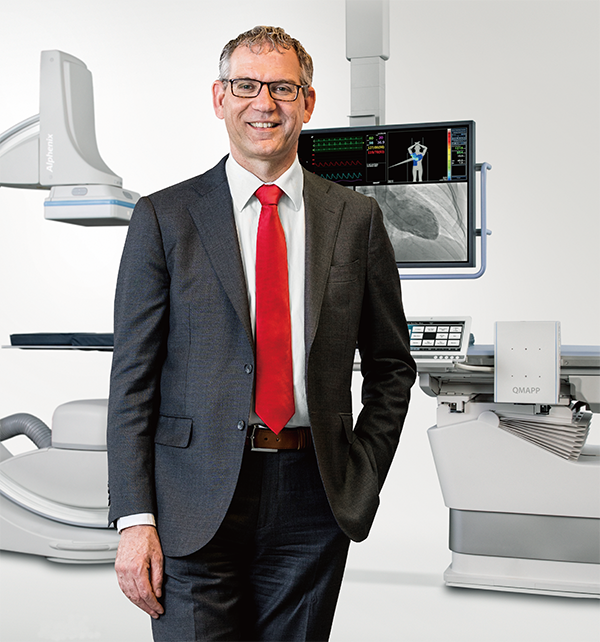 VISIONS spoke with Eric van Antwerpen, Chief Commercial Officer at Fysicon.
With the acquisition of Fysicon over a year ago, Canon Medical is now able to provide the best image quality with an intuitive hemodynamic monitoring solution, a powerful combination in cardiac care. Eric van Antwerpen, Chief Commercial Officer at Fysicon, discusses how in areas such as interventional radiology and stroke Canon Medical’s solutions and its sister company can better fit the needs of the customer and improve patient outcomes.
With the inclusion of Fysicon, Canon Medical now has a broad range of solutions across different modalities, clinical scenarios and workflow systems designed to add real value to the services offered by the hospital. This ability to provide a complete, in-house solution is one of the company’s strongest points, according to Eric. “We are the only ones who can supply a complete portfolio; a one-stop-shop. Having a single solution means you don’t have any integration issues. Everything works together seamlessly.”
With the inclusion of Fysicon, Canon Medical now has a broad range of solutions across different modalities, clinical scenarios and workflow systems designed to add real value to the services offered by the hospital. This ability to provide a complete, in-house solution is one of the company’s strongest points, according to Eric. “We are the only ones who can supply a complete portfolio; a one-stop-shop. Having a single solution means you don’t have any integration issues. Everything works together seamlessly.”
Improving and expanding cardiac care
Fysicon’s most well-known product is QMAPP®, a hemodynamic monitoring system. QMAPP beautifully completes the powerful Alphenix interventional system with cardiac workflow, cardiovascular reporting system and database, to deliver our best possible cardiac imaging and workflow solution. “Today everything inside the hospital is IT-connected. Fysicon adds greater IT connectivity and workflow management to enhance our cardiac solution,” he said.
Combined with the Alphenix cardiovascular X-ray system, QMAPP provides a complete solution for the cardiac lab. For hemodynamic applications, the system typically needs to be replaced after seven years.
The average lifetime of cardiac or X-ray equipment in a dedicated lab or X-ray room, is between eight to ten years. Everything can be planned directly with the customer, to renew equipment and IT when it best makes sense, on a case-to-case basis.
Used in combination with the Alphenix Core, QMAPP also enables to perform cardiac imaging inside a catheter lab, which may prove a smart business decision for small hospitals, Eric explained: “In a general district hospital you facilitate 300 to 350 procedures a year. In a cath lab, that’s too expensive. But by having a system like the Alphenix Core and an upgrade kit such as QMAPP, you can perform cardiac care in this setting, and save money for your hospital.”
Information on stents, balloons, devices, valves and any implants are also stored on QMAPP, and can be sent to registries. If companies have an issue with their product, they can consult QMAPP data to find out.
If a facility performs 320 procedures per year in their cath lab, they would break even within approximately five years, while it usually takes a decade for a cardiac lab to generate benefits. “With optimal workflow, customers can add one or two patients per day, which is good from a budget perspective. For patients, it means shorter waiting times before they can have their procedures done,” he added.
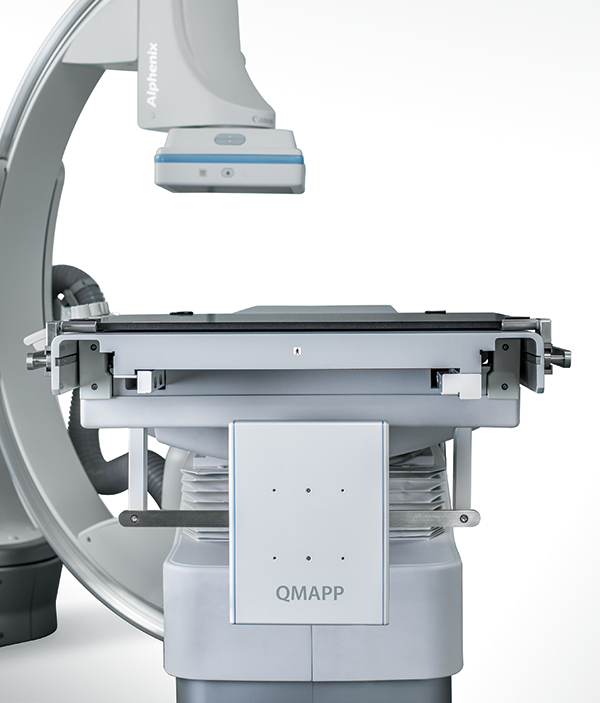 QMAPP attached on Canon Medical’s X-Ray system Alphenix.
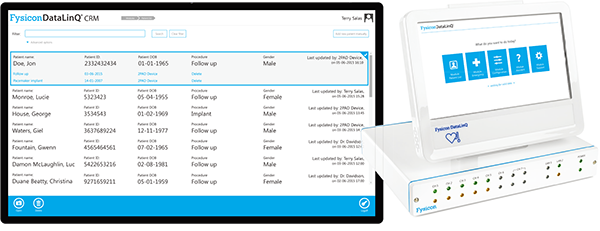
DataLinQ™ is another workflow management system used to facilitate a paperless pacemaker clinic and make pacemaker follow-ups more efficient and less costly. Usually, pacemakers are implanted in the cardiac catheter lab. Fysicon facilitates an IT solution where all the data from the pacemaker is directly fed into the database. Pacemaker follow-ups are usually performed once or twice a year. In the past, all the data generated by the pacemaker in that time was printed on paper, in 4-12 pages-long reports, which were then put into files. When the patient returned to the hospital for a follow-up, the physician don’t have time to go through the long reports and would typically read only the first pages.
“An IT system, allows you to directly access all key information on battery state, lead wires, settings etc. and, if necessary, plan a replacement in time based on the trends. You can better follow-up patients and track any changes in their behavior. These trends become evident as all the data on the patient’s wellbeing is stored in the system,” Eric explained.
With DataLinQ Remote Device Management it is also possible to integrate data from remote device systems into DataLinQ Cardiac Rhythm Management. A message is automatically displayed in the inbox when data from remote device systems are delivered through the hospital server. Both follow-up as well as remote follow-up data are integrated into one database. All the data generated by DataLinQ is exported to national registries, helping to collect data to activate alerts and appropriate chain of actions in case a defect is spotted.
Future applications
The burden of cardiovascular disease (CVD) is set to increase drastically over the next decades. CVD is already the most common cause of death in Europe, responsible for 3.9 million deaths each year. It is a major cause of disability and reduces quality of life. Longevity, improved survival, obesity and the rapidly increasing prevalence of diabetes will continue to boost the number of patients with CVD.
These factors directly have an impact on rising costs for healthcare and put further strain on healthcare resources. It is currently estimated that CVD costs € 210bn a year to the EU.1
Optimized workflows and improved resource utilization are crucial to help buckle the trend. The combination of Alphenix and QMAPP can help detect CVD at an early stage, before any complications, such as stroke, arise. Other modalities can also be used to help in the early diagnosis of CVD. The focus should now be on multi-modality sales and along clinical pillars - i.e. cardiology, oncology.
“Selling modalities doesn’t work anymore. It’s important to think across the clinical pillar because we can offer a whole approach, for example a complete cardiac solution. You can’t do everything with one device and that’s why you need to use the whole portfolio.”
Canon Medical has several high profile academic sites equipped with Alphenix 4D CT, a sliding CT system integrated with an interventional system that can also be combined with ultrasound. This one-room solution avoids the complications and time delays of patient transfer.
“We are continuously looking for opportunities to make the current workflow more efficient, by combining additional modalities, and improving integration and usability,” Eric said.
Smarter, safer and cheaper image transfer
Since 2004, Fysicon develops products based on real world needs, for example, from observations made in hospitals. “We saw a nurse walking by in a cardiac thoracic center with a shopping trolley full of CDs and film scans. These imaging studies were being returned by mail to the hospital that created the images, where, according to Dutch legislation, they had to be stored. We thought: this is a wasteful practice. We have to facilitate the transfer of images, and make it more reliable and efficient,” Eric said.
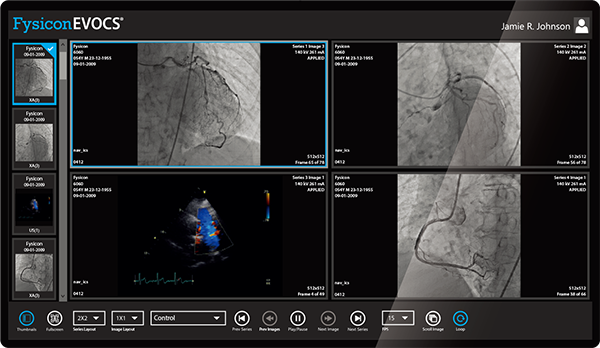
Stroke is another potential use for EVOCS. Time is brain in stroke management, and EVOCS can help make a difference. “We can help save time when a patient CT information is sent to the neurovascular reference center, to help the neurosurgeon to get the data as soon as possible and trigger the appropriate chain of actions - i.e. keep the patient in observation or prepare the OR right away, when there’s a major bleed that needs to be coiled. This is a much more efficient and cheaper workflow compared to current processes.” EVOCS proved its benefits in the Mr Clean Study, which is the fundament for the Dutch Stroke program.2
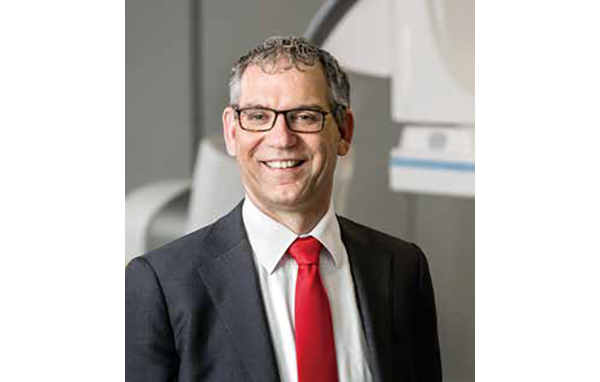
“With the inclusion of Fysicon, Canon Medical now has a broad range of solutions to add real value to the services offered by the hospital.”
Eric van Antwerpen
Joined the Fysicon team in 1996 as freelance application specialist.
Before that he had been working as a radiographer, specializing in angiography and diagnostic cardiac care for over ten years.
This article is a reprint from the international VISIONS magazine #33, published by Canon Medical Systems Europe B.V.
Social Media


